
Complete Guide to Off-Page AEO, SEO & AI Visibility
Master off-page SEO for the AEO era. Learn how entity recognition, citations, sentiment, schema, and monitoring boost Answer Engine Optimization.
51 min read

Originally published June 2025. Substantially rewritten August 2026.
It's been about a year since I first published this guide, and quite a bit has changed. Actually, a lot has changed.
Google expanded AI Overviews and rolled out AI Mode. ChatGPT Search started showing up in real referral data. Google published actual guidance for its generative AI features, which we had been waiting on for a while. And Search Console finally began reporting AI visibility separately.
Some of what I wrote last year held up fine. Some of it didn't, and I'd rather walk you through those parts than quietly edit them out.
The good news is that the foundation hasn't moved much. Know who you're writing for. Answer what they're actually asking. Add something they can't get elsewhere. Make it easy to navigate. Say who wrote it and why they're worth listening to. Keep it accurate. Make sure the crawlers can reach it.
In other words, do SEO well.
Does AI search add new considerations? Absolutely. Conversational queries, citations versus mentions, crawler access, agent readability, and measuring visibility when a lot of it never produces a click. Does it mean throwing out 25 years of search knowledge? Not even close.
One quick note on scope before we get into it. This guide covers what you control on your own site. What other sites say about you, where you're mentioned, and whether authoritative sources treat you as an expert all shape how AI systems understand your brand.
That half of the work lives in our Complete Guide to Off-Page AEO, SEO and AI Visibility. (will also get a rewrite soon!)
Let's start here, because it would feel a little strange to write about trustworthy content while quietly deleting my own bad advice.
Think of the past year as one long test. We formed some hypotheses, we ran them, and we got results back. Several held up. These didn't.
Content chunking is not a requirement. It was recommended to break pages into smaller, self-contained modules so AI systems could retrieve them more easily. So many took it way too far, creating one sentence paragraph after another. Clear sections are still good practice, but Google has since said there's no need to divide content into tiny pieces, that its systems can understand multiple topics on one page, and that there's no ideal page length. So keep writing in focused sections, because readers scan. You just don't need to chop your article into answer cards.
llms.txt does not control model training. I said it was coming, and it sure doesn't look like it is. It sat on this page for a year, so if you read it here, I apologize. More on what the file actually is further down. The short version: Google has said it doesn't use llms.txt for Search, AI Overviews or AI Mode, and we haven't seen broad evidence that it moves citations elsewhere either.
"Search Console doesn't report AI Overview impressions yet, but it's expected soon." Well, it's here. Google launched generative AI performance reports on June 3, 2026. There are some important caveats, which we'll get to in the measurement section.
SGE and AIRS are retired. SGE became AI Overviews and AI Mode. AIRS was a term I was using that never really caught on anywhere outside this article, so I've let it go.
If you cited last year's version somewhere, consider this your heads-up. And if you're a client who implemented FAQ schema on our recommendation, keep reading. There's an important distinction there.
If you only read one section, make it this one. A page that performs in AI search should:
Is there a trick in there somewhere? No. Is there a repeatable process? Yes, and that's the whole point. If you're saying to your self, "Hmmm... Sounds a lot like SEO to me." you're right.
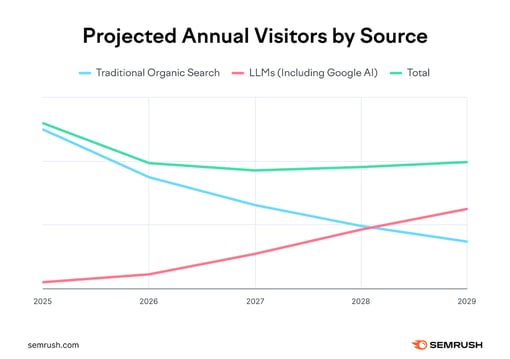 A Semrush study projects that visitors from AI search will overtake those from traditional search by 2028, reflecting a major shift in how people find content online. This trend isn’t happening in isolation; user behavior is already changing. For instance, ChatGPT’s weekly active user count exploded 8× from late 2023 to April 2025 (now over 800 million), signaling massive adoption of AI tools for search-like queries.
Google has introduced AI-driven results in the form of AI Overviews and an AI Mode search interface that summarizes answers at the top of results, reducing reliance on the classic “10 blue links”. In fact, recent data shows nearly 60% of Google searches result in no clicks because the answer is provided on the results page. People are also increasingly turning to non-traditional platforms, about 40% of Gen Z users prefer searching on TikTok or Instagram over Google. All of this underscores that visibility now hinges on appearing in AI-generated answers and across diverse search platforms, not just traditional search rankings.
Consider the SEO software tool industry. I recently had a conversation with a major SEO tool provider who was demoing their new AI SEO tools for me. During this conversation, I noted that their old tools were likely to become obsolete in the near future, to which they all uncomfortably nodded in agreement. This is where we all are.
Also consider BCM! Some of the highest-performing organic search keywords for the BCM website trigger AIO results in Google, providing us with less click data to measure success.
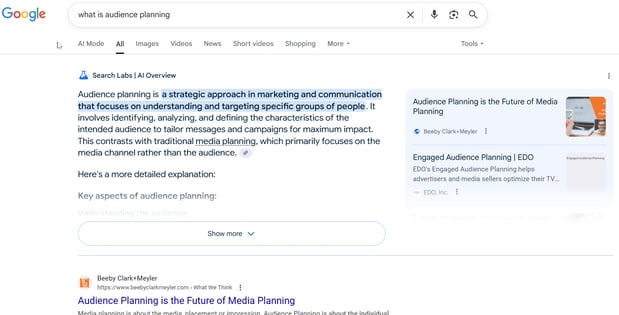
AI search optimization is the practice of making your content discoverable, understandable and citable by systems that generate answers instead of just listing links.
In practice it covers five things. Making sure AI crawlers can actually reach your content. Writing so a system can pull a correct answer out of it. Giving that system a reason to trust and cite you rather than someone else. Connecting your site to credible signals elsewhere on the web. And measuring visibility when a lot of it never produces a click.
You'll see it called AEO, GEO, LLM SEO and a few other things. Those distinctions matter less than most suggest, and we'll get into why in a minute.
What it isn't: a separate channel, a plugin, a file you upload, or a rewrite of your site into robot-friendly fragments. If someone offers you an AI search product that requires none of the technical or editorial work described here, ask a lot of questions before signing anything.
Search stopped being a single page a while ago.
Someone might start a question in Google, hit an AI Overview, carry the conversation into ChatGPT, watch a YouTube video, read a Reddit thread they trust more than any of it, and eventually type your brand name directly into the address bar. Someone else gets a good enough answer in the AI response and never visits anyone's site at all.
So are websites becoming irrelevant? No. But they're now serving two audiences at once: the person reading the page, and the system deciding whether the page is worth ranking, summarizing, citing or recommending.
Google's AI Overviews and AI Mode still link out, and Google's position is that existing SEO fundamentals are what make you eligible. No secret tags. No AI submission form. The page needs to be crawlable, indexed and eligible to appear with a snippet, same as always.
Which means the opportunity isn't to abandon organic search. It's that one good page can now earn a traditional result, a featured snippet, an image or video placement, a supporting link in an AI Overview, a citation in AI Mode, a link in ChatGPT or Perplexity, a brand mention with no link at all, and a branded search three days later from someone who saw your name in a chatbot and remembered it.
Our measurement got harder because the journey got messier. That isn't a reason to measure less.
We see it on our own site, too. Several of BCM's better-performing organic keywords now trigger AI Overviews, which means we have less click data to prove success on our own marketing. Physician, heal thyself.
And it isn't just us. I sat through a demo not long ago with a major SEO tool provider walking us through their new AI features, and I mentioned that a good portion of their older toolset was probably headed for obsolescence. Everyone in the room nodded. Nobody argued.
That's roughly where the industry sits right now.
Gotta love marketing acronyms!
SEO is the broad discipline: technical accessibility, relevant content, site architecture, authority, user experience.
AEO, answer engine optimization, generally means making your information likely to be selected as a direct answer.
GEO, generative engine optimization, focuses on visibility inside generative responses.
LLM SEO is the informal one, usually meaning mentions, citations and recommendations inside AI assistants.
Are the distinctions useful? Sometimes, when you're describing a specific tactic or building a report. Do they justify four separate strategies with four separate budgets? They do not, though I understand why the people selling them would prefer otherwise.
What you're really optimizing for is discovery. That covers rankings, AI Overviews, AI Mode, ChatGPT Search, Perplexity, Copilot, Gemini and whatever ships next quarter.
A strong page doesn't need four versions written for four acronyms. It needs to be the most useful and most trustworthy thing your organization can publish on that subject. If you want the longer argument, I made it in AI Search Did Not Break SEO. It Exposed It.
Most AI search experiences use some form of retrieval, usually called retrieval-augmented generation (RAG). Rather than answering purely from training data, the system runs searches, pulls sources and builds an answer from what it found.
Google's generative features are wired into its search index and its existing quality systems. ChatGPT Search retrieves from public sites and third-party search providers. Perplexity, Copilot and Gemini each have their own mix of crawlers, indexes, models and retrieval logic.
Which is why there's no universal AI ranking. The same question can produce different sources depending on the platform, the model version, the date, the location, the exact wording and whatever was said earlier in the conversation. If someone offers to sell you a single "AI rank" number, they're selling you a number.
AI Mode is Google's conversational search interface. You ask a question in plain language, it assembles an answer from retrieved sources, links out to those sources, and lets you keep asking follow-ups in the same thread.
It matters for a few reasons. It handles longer and messier questions than a keyword box ever did, so it can surface your content for phrasing you never targeted. It uses query fan-out, so one question may pull from a dozen different pages. And its impressions land in your Search Console data, which is where a fair amount of unexplained impression growth has been coming from lately.
AI Overviews and AI Mode are related but not the same thing. An AI Overview appears above traditional results on a normal search. AI Mode is its own surface with its own conversation. Both link out, and both follow the same eligibility rules: crawlable, indexed, snippet-eligible.
Google has confirmed that AI Overviews and AI Mode can use query fan-out, issuing multiple related searches across subtopics before assembling a single answer.
An example: Take a traveler asking...
"What's the best Florida beach town for a family with young kids visiting in March?"
Behind that one question, the system may also be searching March weather, water temperature, calm-water beaches, walkable downtowns, spring break crowd timing, family attractions and nearby airports.
Think of it like a research assistant who takes your one question, splits it into eight, and comes back with a synthesized answer. Your page doesn't have to win the original question. It has to be useful for one of the eight.
That's the opportunity. Keyword research tells you how people search. Fan-out tells you what's packed inside a single complicated request.
It does not mean building a thin page for every possible sub-question. Google specifically warns against rewriting content for AI systems or manufacturing pages to catch every long-tail variation, and its systems handle synonyms, related meanings and passage-level relevance within a larger page.
Aim for complete. Not multiplied.
Every content strategy that works starts with knowing who you're talking to. AI search made that more important, not less, because people now describe their entire situation in the prompt.
"People interested in Florida travel" isn't an audience.
"A parent planning a first Florida trip with two kids under six, who wants a quiet beach, a short drive from the airport and things to do that don't eat a whole day in the car" gives a writer something to work with.
That definition drives the questions you research, the examples you choose, how deeply you explain things, the images, the calls to action, all of it. You can't sprinkle relevance on at the end like a garnish.
Which is why audience planning is step one in our content process rather than step six. We use the same audience work to drive media strategy, messaging and content, because it's the same question in all three: who is this actually for?
Prompts are longer and more specific than keywords ever were. People tell the machine who they are, what they need, what they want to avoid and which tradeoffs they'll accept. Content written for a vague audience isn't going to satisfy a specific one.
That’s why BCM invests heavily in audience planning tools not just to inform paid media strategies, but to power smarter content creation. Whether we're building a campaign or writing a page, audience understanding is the performance multiplier and ALWAYS the first step.

In short: if relevance is the new currency of AI search, then knowing your audience is how you earn it. Align your content with real audience intent, and you'll be better positioned to win in any AI-driven discovery environment.
Know What Your Audience Wants
Understanding your audience is one thing; knowing exactly what information they’re seeking is another. In the age of AI search, this goes beyond traditional keyword research into the realm of topic and question research.
AI-driven search queries tend to be more conversational and specific than the terse keywords of old. Users ask natural-language questions like they’re talking to an expert. To meet this need, conduct research to discover the common questions and subtopics within your niche. Tools like People Also Ask boxes, community forums, and AI query and prompt research can reveal what real questions your content should answer.
 Once you identify these questions, shape your content to address them directly. This is sometimes called Answer Engine Optimization (AEO) - optimizing your content so that AI “answer engines” can easily extract and present your answers. For example, if users often ask an AI, “How do I choose the right running shoes for flat feet?”, you should have a section explicitly answering that, rather than burying the advice in a generic paragraph. Prompt shaping is useful here: phrase key points as Q&A or in statements that read like succinct answers. Not only does this help human readers scan, but it also aligns with how AI models parse content. In fact, Google’s AI search systems often retrieve specific passages, not entire pages, so wording matters at the snippet level. Studies have shown that AI prompts are far more conversational than traditional search keywords, meaning content creators must anticipate and answer these natural-language prompts in their writing. Writesonic reports that traditional Google searches average 4.2 words, whereas AI prompts, such as those used with ChatGPT, average 23 words. This indicates a significant move toward more context-rich and nuanced user inputs. By doing thorough topic research and shaping your content around the actual questions people ask, you increase the likelihood that your content will be the one AI chooses to quote or cite in response.
There's been a fashionable push lately to declare keyword research an obsolete SEO relic.
I'd push back on that.
Keyword data still tells you about demand, terminology, intent, seasonality and competition. And Search Console gives you something even better: the actual queries already generating impressions and clicks on your site, which is to say, what Google already believes you're about.
What's changed is that keywords are now one input among several. We look at traditional keyword data alongside People Also Ask, related searches, on-site search logs, sales call notes, support tickets, reviews, Reddit threads, YouTube comments and prompt data from AI visibility platforms.
Each one answers a different question:
What should come out the other end of all that? An understanding of the subject. Not a spreadsheet with 500 variations of one phrase and a color-coded priority column nobody will ever open again.
Google's guidance for its generative features leans on content being valuable, unique and non-commodity. That's probably the most useful phrase in this entire discussion.
Commodity content repeats what's already out there. Same five tips, same three statistics, same conclusion. A model can generate that in seconds now, and increasingly it just does, without citing anybody.
Non-commodity content contributes something. Original research. First-party data. Firsthand experience. Expert commentary. A documented process. A real case study. A tested recommendation. An opinion you're willing to defend.
The test is one question:
"What will this page contain that a reader can't get by asking a model to summarize the existing search results?"
If the honest answer is "nothing," the page isn't ready yet.
We applied this to more than 200 destination pages for VISIT FLORIDA, and it's the clearest example I can point to of the difference between using AI and building a process.
The pages were high-value and high-intent, and they were underperforming in AI Overviews. Writing 200+ pages by hand at the quality required wasn't going to happen at any sensible cost.
So we built a workflow. AI and automation handled research organization and initial content development, identifying the highest-volume traveler questions for each destination. Then human fact-checking, editorial review, SEO strategy, technical optimization and structured data went on top, with a checkpoint at every stage and VISIT FLORIDA's content team holding final approval.
That workflow is where Verity came from. It started as a way to get 200 destination pages done properly, and it's since become the process and interface we run all of our content through. More on how it works a bit further down.
The results:
The full breakdown is in the VISIT FLORIDA AI-driven SEO and AEO case study. The work was named a finalist alongside Adobe in the 2026 Digiday Content Marketing Awards for Best Use of AI in Content Production, a brand new category that year, which we wrote about here.
I'm including it for one reason. That result did not come from telling an AI platform to write 200 SEO pages. It came from a repeatable system where automation did the parts automation is good at, and experienced people stayed accountable for strategy, accuracy and final approval.
We call the model Test, Scale, Verify. Test the workflow on a controlled set of pages. Scale only once it's earned it. Verify facts, brand alignment, intent and technical implementation before anything publishes.
If you are a BCM client, and we're involved in content production with you, this same process is what is driving that content development.
Worth addressing directly, since you've probably read that FAQ rich results are gone.
The VISIT FLORIDA work involved identifying the real questions travelers ask about each destination, answering them clearly on the page, and marking them up. Google retired the expandable FAQ rich result in SERPs, it did not retire the value of finding out what people want to know and telling them AND giving machines an easier path to reading that content.
The display feature went away. The content work is what drove the visibility, and it still does. So if your takeaway from the FAQ deprecation is "no need to produce and publish FAQs," that's the wrong conclusion.
A well-structured page is easier to read and easier to interpret. That much hasn't changed.
One clear H1. Descriptive H2s and H3s. Focused paragraphs. Useful internal links. A logical path from the reader's question to the answer to whatever they should do next.
Long articles should have a table of contents or jump links. There's one at the top of this page, and it would have been awkward to leave it off.
Structure should follow the information. It shouldn't replace it. That's the distinction I missed last year, and it's the one most of the early AI content advice missed too.
Since "AI-optimized content structure" has become its own cottage industry, here's the version that holds up:
Notice what's missing from that list: no word-count target, no required section length, no rule about splitting every idea into a self-contained card. Structure exists so people can find things. Retrieval benefits are a side effect of doing that well.
When a heading asks a direct question, answer it in the first sentence.
"Does schema markup guarantee inclusion in AI Overviews?"
"No. Structured data helps Google understand explicit information about your page and can make you eligible for supported rich results, but Google doesn't require special schema for AI Overviews or AI Mode, and correct markup never guarantees display."
See how that first sentence did the work? The paragraph after it fills in the detail. That's good writing, good user experience and good answer optimization all at once.
You don't need to hold every conclusion until the end of the section like the reader signed up for a season finale.
In the AI era, it’s not just whole pages that rank - portions of pages can rank, too. This is where content chunking comes in. Google’s advanced indexing can evaluate and surface specific passages or “chunks” of a page independently. In practical terms, an AI-powered search might pull a single paragraph or a few sentences from deep within your article if that snippet directly answers a user’s query. To capitalize on this, you should write in modular, self-contained chunks that address distinct subtopics or questions.
This is the new content best practice and takes no additional effort. It's simply about the structure of your written content.
How do you do this? Start by breaking down complex topics into smaller sections, each with a clear 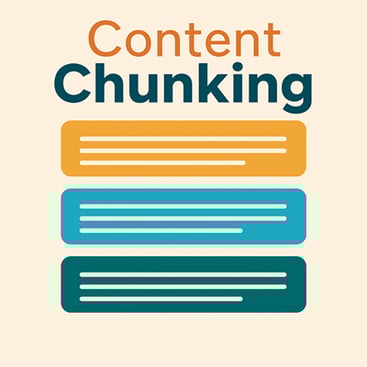 focus. For example, instead of one long article about “Digital Marketing 101,” create sections like “What Is Digital Marketing?”, “Key Channels in Digital Marketing”, “Measuring Digital Marketing Success”, etc., each under its own heading. Within those sections, ensure that each paragraph or group of paragraphs sticks to one specific idea and could stand alone. Google’s passage indexing will reward this by potentially ranking that single passage for related queries.
It also helps to phrase some headings or sentences as questions and answers. This aligns with “micro-answer optimization,” which is about providing succinct, direct responses to common queries within your content. For instance, you might have an H3 asking “How often should I update my website’s content?” followed by a concise answer. This Q&A format is gold for AI - it’s highly likely to be extracted as a direct answer snippet. Even if you’re not using a Q&A format, be explicit and specific in key sentences. Avoid requiring too much context from previous paragraphs; each chunk should make sense on its own.
The benefit of content chunking is twofold: it caters to skimming readers and it caters to AI systems that use passage-level retrieval. By writing focused, answer-driven content modules, you increase the odds that some part of your page will hit the bullseye for a user’s detailed query and be elevated to an AI answer or featured snippet. Think of each chunk as an island of insight that could be discovered independently. In summary, don’t bury the answer 800 words deep in a sea of text - break it out, label it clearly, and you’ll be far more discoverable in the AI search world.
Take note, this page is broken out into chunks as described above. See what I did there? ;-)
Quality and credibility of content matter more than ever in AI search results. Google’s emphasis on E-E-A-T, which now stands for Experience, Expertise, Authoritativeness, and Trustworthiness, carries into the AI realm. In 2022, Google even updated its guidelines to add “Experience” to the E-A-T criteria, reinforcing the need for content creators to demonstrate first-hand or life experience on a topic. But what does all this mean for crafting content?
Firstly, expertise: ensure that your content is factually accurate, comprehensive, and reflects deep knowledge. If you have credentials or years of experience in the subject, say so (an author byline or brief bio can help establish that credibility). AI systems often favor sources that are known authorities—either big names or sites that consistently produce high-quality, cited work.
Next, authoritativeness: build your content on sound research and reference reputable sources where appropriate. For example, linking to credible statistics or official guidelines not only helps users but also signals to algorithms that your content is well-grounded. It’s akin to providing references in an academic paper. Authoritative content tends to attract natural backlinks and mentions, which further boosts your overall site authority - a virtuous cycle that benefits AI visibility too.
Then, trustworthiness: this covers everything from the accuracy of your claims to the transparency of your content. Avoid clickbait or exaggerated promises that could undermine trust. Instead, be honest and clear. If you’re writing about a health or financial topic (YMYL - “Your Money or Your Life” areas), citing medical professionals or financial experts, and including disclaimers where necessary, can enhance trust. Also, maintain a professional site design (no spammy ads or malicious scripts) as site quality can affect perceived trust.
Lastly, the new experience element means highlighting personal experience or firsthand knowledge where relevant. For instance, an article about “best project management tools” can stand out if the author notes that they have 10 years of project management experience and have tried all the major tools. Anecdotes or case studies can demonstrate that experiential depth.
Google’s own guidelines reiterate that its systems reward content that demonstrates expertise and trustworthiness. In fact, content that Google’s AI surfaces often comes from sites that have built a strong E-E-A-T profile over time. So, as you create content, infuse it with expert insight, back it with authority, and polish it for trust (proper grammar, updated information, secure site). Over the long term, focusing on E-E-A-T not only improves your human audience’s perception but also directly influences how AI and search engines rank and feature your pages. Quality content isn’t just the same old mantra here, but a strategic asset. The shift to AI-driven results rewards pages demonstrating expertise and trustworthiness. Make sure yours is one of them.
We know that our clients' most engaging content related to topics that people are interested in is the top performer. This isn’t rocket science, though it can take a series of attempts to find the right formula.
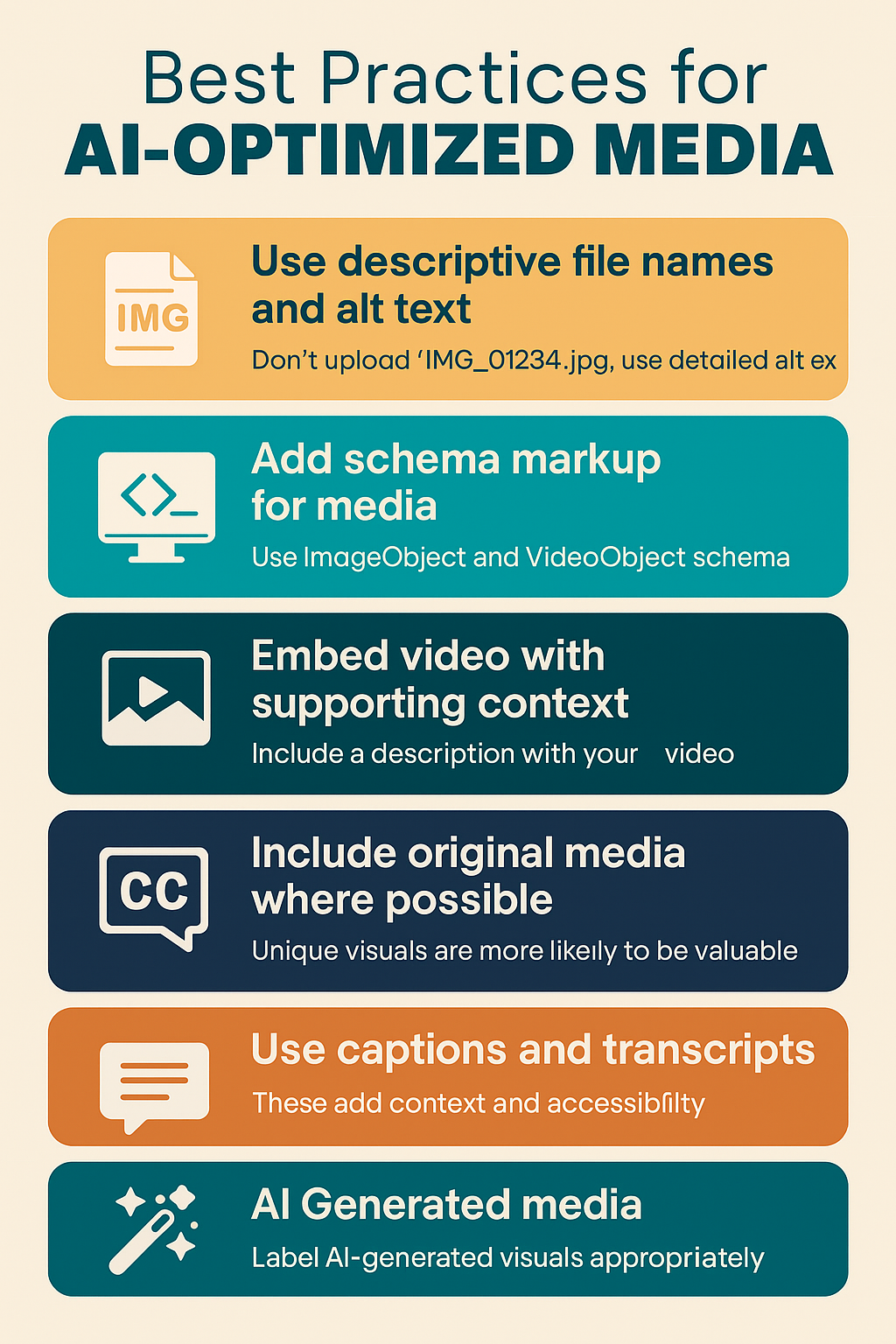
Incorporating media, especially images, video, charts, and diagrams, has always been a powerful way to enhance user experience, but in the AI search era, it can also directly influence how your content is understood, summarized, and surfaced by AI systems.
Here’s why media matters for AI search:
(Yes, ChatGPT created the above infographic and some of the other images on this post. ;-))
To resonate with AI-driven search, your content should be written in natural, conversational language - but also packed with semantically rich terms related to your topic. Why? AI models have become extremely good at understanding context and intent. They favor content that reads like it was written for humans, not search engines. Gone are the days of awkwardly repeating a keyword 20 times; instead, focus on covering the topic in a clear, flowing manner using a variety of relevant terms and phrases.
Write how you speak. This means using a conversational tone appropriate to your audience. If your audience is marketers and business owners, you might say, “Let’s consider an example…” or “You might be wondering…”. This kind of tone can make your content more accessible and engaging, and AI models trained on vast swaths of human text tend to retrieve content that matches the conversational style of a user’s query. In fact, Google explicitly recommends using natural language and avoiding an over-optimized, keyword-stuffed approach - their AI systems prefer “conversational, informative content that addresses user needs”. So instead of writing: “best running shoes flat feet,” you’d write: “What are the best running shoes for someone with flat feet? Based on podiatrist advice, here’s what to look for…”.
Use semantic variation. Think of all the related terms and subtopics associated with your main topic and incorporate them naturally. This not only provides comprehensive coverage (good for your human readers) but also helps AI understand the breadth of your content’s relevance. For example, an article about electric cars might naturally mention charging stations, range anxiety, battery life, EV tax credits, Tesla, etc. These related terms signal that your content has depth. AI engines build knowledge graphs of entities and concepts. By including relevant entities (with context) in your content, you increase the chances of being seen as an authoritative source on the topic cluster.
Also, answer implied questions within your content. Use the question-and-answer format where possible, as discussed in chunking. If your section heading is a question, answer it directly in the first sentence of that section, then elaborate. For instance: “Q: What’s the difference between a credit score and a credit report? A: A credit score is a numerical rating, while a credit report is a detailed history…”. This style caters to the way people ask questions and the way AI will likely extract answers.
Avoid jargon overload unless your audience expects it, and when you use industry terminology, consider providing a brief definition. AI can sometimes simplify or explain terms if the user asks, and if your content already includes the explanation, it’s more likely to be chosen. For example, stating “CMS (Content Management System)” the first time you mention CMS ensures that even if an AI is summarizing, the meaning is clear to everyone.
Lastly, maintain good grammar and coherence. AI models like content that is easy to parse. Shorter sentences and active voice can help with clarity, but vary your sentence structure enough to keep it interesting. The goal is a clear, conversational style that mirrors how a helpful expert would explain the topic to a curious reader. If you find yourself writing something that feels unnatural just to include a keyword, pause and rephrase it. It’s better to write something that a user would upvote as an excellent answer on a forum - that’s the kind of content AI loves to serve. As one actionable tip: optimize for passages, not just pages. Each paragraph should convey a complete thought clearly. This way, whether a user skims or an AI plucks out a single passage, the message is intact and understandable. Write for humans first, and the AI will follow.
 In fast-moving sectors, today’s helpful answer can become tomorrow’s outdated information. Freshness matters - both to users and to search engines (AI included). Generative AI tools typically draw from their indexes or training data which may be at some point in the past but, they use current data provided by search engine results (ChatGPT uses Bing search and this is a whole other topic), so keeping your content refreshed improves the likelihood that your information is current in the AI’s “mind”. From an SEO perspective, regularly updating and republishing content can provide a ranking boost or at least sustain your visibility over time. More importantly, it signals to algorithms that your content is being maintained and remains relevant.
So, how do you keep content fresh? One approach is to establish a periodic review cycle for your important pages or posts. Every so often (e.g., quarterly or annually, depending on the topic), revisit the content to check for any facts, figures, or recommendations that need an update. Did new research emerge? Are there new tools or techniques in your industry that warrant mention? By integrating the latest insights, you ensure your content stays authoritative. Even minor updates like adding recent statistics or examples can help. For instance, if you have a piece about “Social Media Marketing Trends,” updating it with data from 2025 and republishing can make it far more attractive to searchers (and AI) looking for the newest info.
Beyond updates, consider the timestamp. Google’s AI summaries often show the publication date of cited articles. A very old date might imply stale info, whereas a recent date could suggest more current relevance. If you substantially update an article, you may choose to indicate as such (e.g., “Updated June 2025”) and even adjust the publish date if appropriate. This isn’t about gaming the system; it’s about legitimately keeping content up-to-date and informing readers that it’s refreshed. Some sites have found success with republishing old content after significant updates, effectively giving it new life and improved rankings.
Also, capitalize on content freshness for trending queries. AI search, like traditional search, will prioritize timely information for queries that demand it (think breaking news, latest guidelines, etc.). If your niche has any element of news or rapid development, be sure you’re producing content that covers those new developments quickly. That way, your site becomes known as a current source. AI models may explicitly favor “newer” sources for questions on evolving topics (for example, an AI might preface an answer with “As of 2025…” which implies it looked for the latest info).
Finally, freshness ties back to user trust. A user is more likely to trust an article that’s been updated recently, assuming the topic isn’t timeless. It gives the impression that the author or business is active and attentive. In terms of internal process, maintain an editorial calendar not just for new content, but for updating existing high-value content. Track which pieces bring in steady traffic and ensure they don’t fall behind competitors’ content in quality or accuracy over time.
In summary, don’t set and forget your content. Treat it as an asset that requires periodic investment. Your goal is to consistently offer the most relevant, accurate answers. Doing so will pay dividends as AI and traditional search algorithms alike reward that freshness with sustained visibility. The perfect piece of content for AI search is one that’s not just well-crafted once, but well-maintained over its lifespan.
All the great content in the world won’t help if search engines and LLM crawlers, and bots can’t properly crawl, index, or interpret it. The technical underpinnings of your content, site architecture, crawlability, and indexation remain mission-critical in the AI search era. Ensure your site meets Google’s technical requirements so content can be discovered and understood.
Start with crawlability: Can search engine bots access your pages easily? This means having a logical site architecture with clean navigation and internal links (more on internal linking later). Important pages should not be buried several levels deep or orphaned with no links pointing to them. Check your robots.txt and meta tags to be sure you’re not unintentionally blocking important content. Google specifically advises to allow Googlebot to crawl and to serve content with a 200 OK status code. Similarly, ensure that your pages aren’t behind login walls or paywalls that prevent AI from training on or retrieving them - if it’s private to users, it’s invisible to AI.
Next, consider indexability: Even if crawled, will your content be indexed and eligible to appear in results? Do not use a noindex tag on pages you want to rank (and conversely, use it if there are pages you want excluded). Keep an eye on your index coverage in Google Search Console to catch any pages that are discovered but not indexed due to issues. Also, site speed and rendering can affect indexation: heavy client-side rendering (JavaScript) might mean Google’s crawler can’t see your content immediately. Large Language Models primarily train on the raw HTML of pages, not on content that only appears after scripts run. Therefore, prefer server-side rendering or static HTML for crucial content. As noted earlier, important text hidden behind interactive elements or requiring user action won’t be seen by AI bots in a timely manner.
Additionally, maintain a solid site architecture. Use a coherent URL structure and organize content into categories or silos that make sense. For example, a recipe site might have /recipes/desserts/chocolate-cake - this hierarchy gives context. A well-structured site helps search algorithms discern relationships between pieces of content, which can enhance contextual relevance. A flat, interlinked structure with relevant cross-links also ensures no page is too far from the homepage.
Don’t forget basic technical SEO hygiene: unique title tags and meta descriptions for each page, proper use of canonical tags to avoid duplicate content issues, an updated XML sitemap to feed search engines your URL list, and using HTTPS for security. While these might seem old-school, they still form the foundation for how content is discovered and ranked. Google’s John Mueller advises that meeting technical requirements “covers you for search generally, including AI formats”. In other words, if your content is technically sound for traditional SEO, you’re off to a solid start for AI SEO as well. Just be mindful of the additional point: AI systems prioritize speed and clarity in crawling, so lean towards simplicity - lightweight, accessible HTML over complex scripts.
Yes, I keep talking about it and am not going to stop!
Structured data, aka “schema markup,” is your secret weapon for speaking directly to search engines and AI in their own language. By adding schema markup to your pages, you provide machine-readable context about your content, which can enhance how your material is understood and presented. Google affirms that structured data helps its systems better interpret your content and can make your pages eligible for special rich results.
For AI search, schema can be especially powerful. Why? Because AI summaries and answers often draw on specific facts or snippets from pages, schema markup explicitly highlights those facts. For example, implementing FAQ schema around common questions on your page might increase the likelihood that Google’s AI will draw directly from those Q&A pairs when formulating an answer. Similarly, the HowTo schema can outline step-by-step instructions, the product schema can feed detailed specs or ratings, etc. In essence, schema markup provides a structured framework that AI can easily parse.
To leverage this, identify what type of structured data fits your content. Some popular ones include: FAQPage (with questions and answers), HowTo, Article (with author and date info), Product (with price, availability), Recipe (ingredients, cooking time), BlogPosting, and Organization (for your business details). Mark up elements that align with what your audience might ask. For instance, if you have a travel article with a list of top restaurants, adding Restaurant schema for each entry (with attributes like cuisine type, rating, price range) could help an AI that’s compiling a travel guide answer. Always ensure that any content you mark up with schema is also visible on the page (don’t add schema for information that isn’t actually shown to users).
Simple Blog Schema Example from the Beeby Clark Meyler blog:

Implementing schema is not overly difficult - often it’s a JSON-LD snippet you can add to your page template. There are many plugins and schema generators, and Google’s Structured Data Testing Tool to help validate it. The payoff can be significant. Pages with schema are more likely to appear as rich results (like those expandable FAQs in search results, star ratings, knowledge panel info, etc.), which in turn signals to users (and AI) that your content is authoritative. Moreover, in Google’s new SGE (Search Generative Experience), we’ve seen AI answers accompanied by citations and even images pulled from pages; having structured data increases the chance your content is chosen for those enhancements. In fact, structured data clarity “increases the chances of appearing in rich snippets and enhanced search features”.
Some of the most common Schema types. See schema.org for more info and Schema types.
| Schema Type | Purpose / Use Case |
| Article | Marks up news, blog, or editorial content to improve eligibility for rich results. |
| FAQPage | Displays questions and answers directly in search results (ideal for AEO/AIRS). |
| HowTo | Enables step-by-step instructions to show as rich results or visual guides. |
| Product | Used for product pages and supports price, availability, reviews, and more. |
| Review / Rating | Enhances snippets with star ratings and reviewer info. It is often embedded in Product. |
| VideoObject | Helps AI and search engines understand embedded video content. |
| ImageObject | Gives context to images (alt text, caption, creator, license) Useful for AI parsing. |
| BreadcrumbList | Displays breadcrumb navigation in results, improves crawl paths, and UX. |
| LocalBusiness | Defines location, contact info, hours, etc. — critical for local SEO visibility. |
| Organization | Establishes business identity, logo, and links to social profiles. |
| Event | For public-facing events. It shows date, location, and ticket info in SERPs. |
| Recipe | Specialized markup for food content. It shows ingredients, time, ratings, and more. |
| JobPosting | Used to surface job listings directly in search with structured metadata. |
| SoftwareApplication | For apps, SaaS tools, or platforms. This includes OS compatibility, price, etc. |
| Course | Used for online courses or educational offerings — includes name, provider, and content. |
| Person | Used to describe individuals (bios, authors, etc.), often nested within the Article schema. |
One caveat: follow schema guidelines carefully. Don’t markup content that doesn’t match or try to spam with irrelevant schema, as Google could penalize or ignore it. Focus on the accuracy and relevance of markup. Done right, schema markup is like adding signposts for AI: it explicitly labels the most important pieces of your content, making it easier for AI to grab the right info to answer a query. In a world where AI might be synthesizing answers from multiple sources, you want to make your source as easy as possible to mine. Schema helps you do just that.
Don't forget about third party schema. It's when another site includes your brand in their schema markup. More on third party schema in our article about off-page AEO best practices.
Page experience has long been an SEO factor, and it’s just as crucial for AI search. Users who click an AI-generated result expect a fast, seamless experience. After all, the AI just gave them a concise answer, so if they choose to “learn more” on your site, don’t disappoint them with a sluggish or cluttered page. Google has made it clear that even the best content will be disappointing if the page itself is slow, confusing, or hard to use. So, performance and UX optimizations are an integral part of “perfect content” for AI search.
Believe me, we understand the ongoing struggle of optimizing website performance. Achieving perfect scores can be challenging, often due to factors beyond your control, like CMS and hosting. However, there's always room for improvement in areas you can influence!
Start with load speed. Optimize images, leverage browser caching, use a fast hosting solution, and minimize render-blocking resources. Google’s Core Web Vitals (like Largest Contentful Paint and Cumulative Layout Shift) are metrics worth monitoring - they rolled these out as ranking factors in 2021 to emphasize the importance of speed and stability. A faster site not only pleases users but also helps with crawling (Googlebot has a budget; a quick-to-load site means it can crawl more pages) and possibly with how AI evaluates quality. If two pages have similar info and one loads significantly faster, it’s reasonable to think the faster one offers a better user experience and might be preferred.
Beyond speed, focus on page clarity and usability. Make sure that when a visitor lands from an AI summary, they can easily find the deeper content promised. If your page is “cluttered, difficult to navigate, or makes it hard to find the main information,” users will bounce - and that negative signal can hurt you. Ensure your content is front and center, not buried under huge banners or interrupted by aggressive pop-ups. Use a clean design with readable font sizes and sufficient contrast. Mobile-friendliness is non-negotiable as well; more than half of searches are mobile, and AI results appear on mobile too.
Consider user engagement signals. While traditional ranking was heavily about relevance and backlinks, AI search could place more weight on engagement metrics - if users consistently click a result and then quickly hit back (because the page was too slow or unhelpful), that content might be deemed inferior. Google’s AI Mode specifically notes the importance of “dwell time” and user interaction as indicators of content quality. So optimizing for a positive user experience (fast load, easy navigation, helpful layout) indirectly boosts your AI search performance by keeping those visitors engaged once they arrive.
In summary, treat page speed and UX as signals of content quality. A snappy, well-structured page is more likely to satisfy users and thus satisfy the AI that sent them there. Use tools like Google PageSpeed Insights or Lighthouse to audit your pages. Trim the fat (excess scripts, huge videos loading automatically, etc.), and test on real devices. Remember, an AI search result might just pull a snippet from you, but if the user clicks through, that’s your chance to shine with a great experience. Don’t squander it with a slow or messy page. Fast, user-friendly pages signal quality to both users and AI, reinforcing that your site is a good destination for future searchers.
BCM runs weekly audits tracking your site’s overall performance, and data on a page-by-page level is also available. We can assist in interpreting this data if needed.
No page is an island - especially in the context of AI understanding. To bolster your content’s authority and visibility, build a network of internal links and content hubs around your topic areas. Internal linking has always been an SEO best practice for distributing link equity and guiding users, but it’s even more meaningful now as AI algorithms attempt to grasp your site’s overall expertise on a subject.
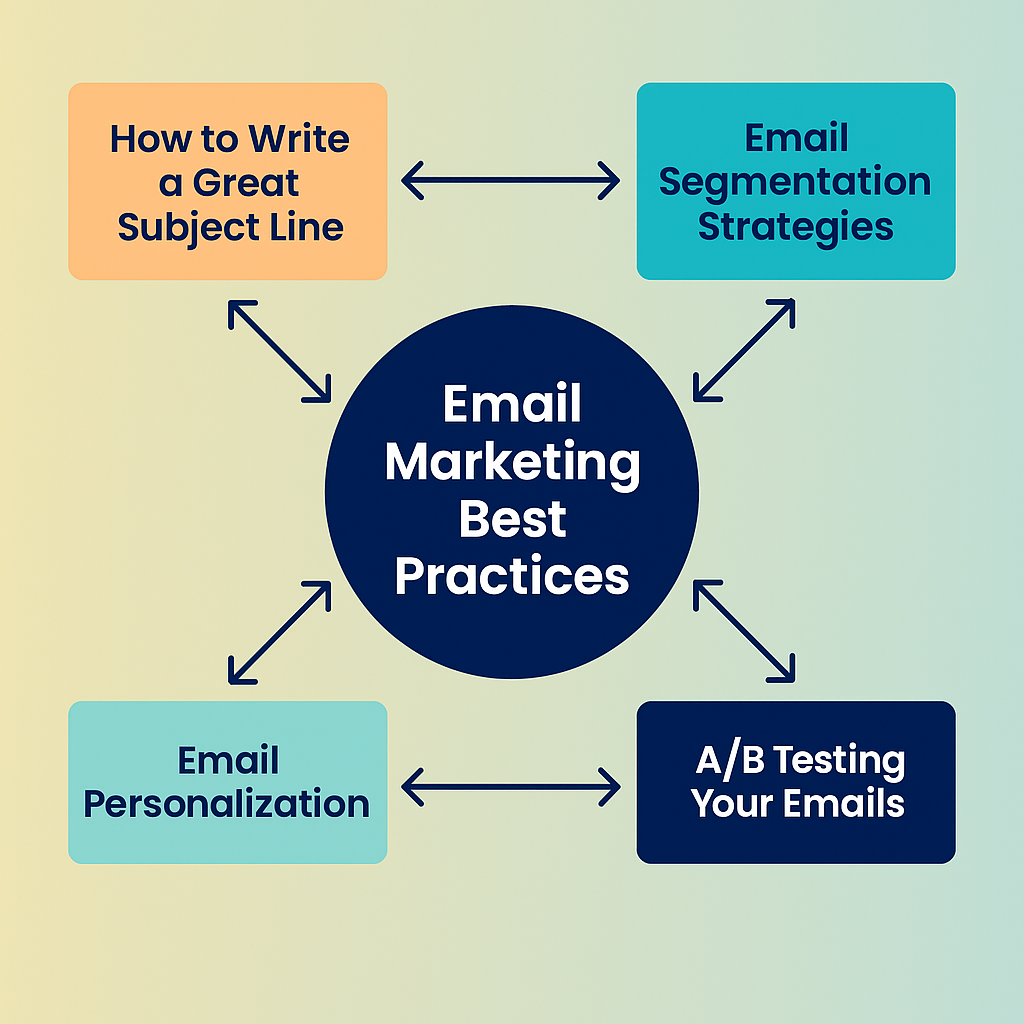
A content hub (or “topic cluster”) strategy can be highly effective. This means creating a central, comprehensive piece of content (often called a pillar page) on a broad topic, and then having multiple supporting articles that dive into subtopics, all interlinked. For example, you might have a pillar page on “Email Marketing Best Practices,” with satellite pages on “How to Write a Great Subject Line,” “Email Segmentation Strategies,” “A/B Testing Your Emails,” etc. Each of those subtopic pages links back to the pillar and to each other, where relevant, forming a hub of interrelated knowledge.
Why does this matter for AI? Because AI search will gauge not just the relevance of a single page, but the depth of coverage a source has on a topic. By clustering your content and linking it, you signal that your site has breadth and depth - a strong topical authority. Google’s AI mode is said to evaluate content across multiple formats and pages, rewarding a “strong topical presence”. In practice, when an AI answers a complex query, it might combine information from different pages of your site (since LLMs can retrieve from multiple sources). If your own pages reinforce each other, you increase the chance that the AI pulls entirely from your ecosystem of content, citing perhaps your pillar page as the main reference.
To implement this, be intentional with internal links. Within your content, whenever a related concept is mentioned that you have a page for, link to it with descriptive anchor text. For instance, in an article about social media marketing, if you mention “SEO ROI” and you have an SEO hub, link the text “SEO strategy” to that page. These contextual links help AI understand the relationships between content pieces. They also help users navigate and spend more time on your site (which, as noted, is a positive engagement signal).
Additionally, ensure your navigation and taxonomy support these hubs. Use categories, tags, or menus to group related content. A well-structured site architecture where, say, all “AI Marketing” content is under an /ai-marketing/ section or at least cross-linked, creates a silo of expertise. Some SEO experts mention the concept of “entity hubs” where all content about a specific entity (topic) is interlinked to create a authoritative resource hub - this can be powerful for AI which builds knowledge contextually.
Another tip: create summary or roundup pages that link out to multiple resources. For example, a page like “Ultimate Guide to Content Marketing” which briefly covers subtopics and links to detailed posts on each. This not only serves as a great user resource, but in AI terms, it positions that page as a central node of information. If an AI is looking for an authoritative source to cite, a page that clearly organizes a wealth of info (with links to deeper content) might be seen as very useful.
Remember to regularly audit internal links as you add new content. Go back to older posts and link to your new ones where relevant, and vice versa. This keeps your content web tight and up-to-date. The outcome of strong internal linking and hubs is a clustered authority: you’re not just answering one question in isolation, you’re answering the entire set of user questions around a topic across your site. That makes you the kind of source AI search would be confident in highlighting. As a bonus, internal linking boosts traditional SEO by improving crawl paths and distributing link equity, so it’s a true win-win.
AI makes content work faster and more scalable. It helps with research organization, topic clustering, outlines, first drafts, metadata, content inventories, schema generation, internal link suggestions and QA passes.
It will also fabricate facts, misread context, invent sources and write with tremendous confidence about things it has no business being confident about.
So the question was never whether AI was used. The question is whether the finished thing is accurate, useful, original and accountable to a person.
Google's guidance focuses on quality and purpose rather than on automation itself. Automated content still has to be accurate, relevant and compliant with spam and structured data policies, and Google recommends giving readers context when automation contributed meaningfully.
You've probably seen AI content that read fine and was wrong. That's the failure everyone talks about. There's a second one that gets less attention: in a traditional workflow, accuracy depends on how carefully one writer happened to work that week, and there's usually no record of what got checked. Neither of those is a prompting problem. They're process problems.
Content engineering is the practice of treating content production as a system with defined stages, verification steps, approval gates and an audit trail, rather than as a craft that happens somewhere between a brief and a deadline.
It's a shift in where the quality control lives. In a craft workflow, quality depends on the person doing the work and on whoever reviews it at the end. In an engineered workflow, quality is built into the stages themselves. Verification is its own step with its own output and its own reviewer. Voice is a configured input rather than a prompt someone retypes each session. Compliance is checked in code rather than self-reported by the model that just wrote the thing.
Think of it like the difference between a great cook and a commercial kitchen. The cook may well produce better food on any given night. The kitchen produces the same food on a Tuesday in February when the cook is out sick, and it can tell you exactly what went into the dish.
Does that mean removing people from the process? Not at all. It means putting them where their judgment actually matters, and giving them something to review other than a finished draft they have to take on faith.
We think this is where content operations is heading generally, and there's more to say about it than fits here. A fuller piece on content engineering is coming, and we'll link it from this section when it publishes.
Verity is our content engineering process, and it's how our content gets produced now. The short version of the philosophy: AI does the heavy lifting, people hold the steering wheel.
I want to be precise about what it is, because this is the part people usually get backwards. Verity is a multi-step, human-in-the-loop process. We've built an application that runs it, and the application makes it consistent and fast at volume. But the process stands on its own. You can run it manually with a spreadsheet, a shared document and some discipline, and you'll get the same protections. The interface simply removes some of the friction.
The process is ten stages with a human approval gate between every one. Nothing advances on its own, and any gate can send the work back to an earlier stage, which then reruns forward from the corrected input rather than getting patched at the end.
The ten stages:
Every claim ends up in a source ledger showing its URL, its status and the reason it passed or failed. Every AI action and every human edit is logged with the text before and after. So if a claim gets questioned six months after publication, answering it is a lookup rather than an investigation.
The VISIT FLORIDA results earlier in this article came out of that system.
Underneath the ten stages sits a simpler rule you can apply tomorrow. Test, Scale, Verify. Test the workflow on a controlled set of pages. Scale only once it's earned it. Verify facts, brand alignment, intent and technical implementation before anything publishes.
Making the process possible and making it consistent at volume are two different problems. Discipline solves the first. Tooling solves the second. Is it perfect? No. Are your copywriters perfect? Do you need to make edits to their drafts? Right. Didn't think so. Verity gets you great content more efficiently. This is what you need to be doing.
Fair is fair, since I've just spent several hundred words on process. This article went through all ten stages. Manually, not through the application, which is the best evidence I can offer that the process is the part that matters.
Keyword research. We started with the real query data for this URL rather than a fresh keyword pull, since the page already had a year of history. That's what surfaced the sections you're reading that weren't in last year's version.
Content brief. Assembled in pieces, honestly. Not a tidy document. The requirements arrived over several conversations and the outline changed twice.
Research. Live sources pulled and attached to their URLs, including Google's own documentation, coverage of the FAQ deprecation, and our own case study and award pages.
Fact verification. This is the stage that earned its keep. An independent check against primary sources caught a figure I had wrong: an earlier draft cited an 800% copywriting saving on the VISIT FLORIDA project. The real number is 88%. That wrong figure also sits on one of our own published pages, which is a good illustration of why verification has to be its own step rather than something you assume happened. Two other claims were cut entirely because they couldn't be supported.
Writing and linking. Drafted from the approved research only. Every external link opened and checked against the live page.
Human editing. Several rounds, including one where I sent the whole draft back because the voice wasn't mine.
Humanization and QA. Checked programmatically, not self-reported. Em dashes, a banned word list, and banned sentence patterns, all verified in code before you got to read it.
Still with me?
Schema and metadata. Generated from the finished text, after the copy was final.
Delivery. A person read the whole thing and signed off. That person was me, so if anything here is wrong, you know exactly where to send it.
Human review isn't a ceremonial signoff at the end. It's the part where you put your name on what the world will see just as soon as you hit "Publish."
I got this one wrong last year, so let's be precise about it.
llms.txt is a proposed Markdown file placed at the root of a site, meant to give participating AI systems a curated guide to your important resources. That word "proposed" is doing a lot of work in the sentence.
Google has explicitly said it doesn't use llms.txt for Search, AI Overviews or AI Mode. Creating one won't help you there, and it won't hurt you either. We also haven't seen broad public evidence that it meaningfully increases citations in ChatGPT, Claude or Perplexity.
And it does not control whether your content is used for model training. That's what I said in 2025, and it was wrong.
Should you make one anyway? If you run a documentation-heavy site, or a service you care about documents support for it, sure. Treat it as a cheap experiment. Just don't put it on a deliverables list next to things that actually move numbers.
It doesn't replace robots.txt, sitemaps, internal links, crawlable HTML, crawler access, structured data or good content. And we don't improve this discipline by swapping one oversimplified myth for a newer, more fashionable one
The next phase isn't just answering questions. AI agents will compare products, check availability, fill out forms, plan itineraries and book things on someone's behalf.
Google's current guidance notes that browser agents may interpret a site through its rendered appearance, its DOM and its accessibility tree.
So an agent-friendly site uses clear labels, semantic HTML, properly associated form fields, descriptive buttons, understandable error messages and navigable structure. Prices, availability, policies, dates and requirements should be readable without inferring meaning from visual design alone.
Here's the encouraging part: this isn't a new discipline. Most of it is accessibility and usability work you should already be doing. A booking form an agent can parse is usually a booking form that also works with a screen reader, a keyboard and a five-year-old phone.
If AI agents are going to play a larger role in how people navigate the web, then being visible may only be part of the job. Being usable could matter just as much. It's probably worth bringing to your web development team's attention now rather than later.
Traditional reporting centered on rankings, impressions, clicks, sessions and conversions. All still useful. All incomplete now, because a brand can be mentioned or cited inside an AI answer without anybody visiting anything.
The path often looks like this: someone sees your brand recommended in ChatGPT, searches your name in Google two days later, and converts through a direct visit. The AI exposure did the work. Last-click reporting is unlikely to receive the memo.
Rather than describe the problem in the abstract, here's this article's own performance for the 90 days ending August 3, 2026:
77,461 impressions. 20 clicks. A 0.03% click-through rate at an average position of 16.
That's the second-highest impression count on our entire website. Twenty clicks.
Under traditional reporting, this page is a failure and I should have deleted it. Under any honest reading of how discovery works now, it's one of the most visible assets we own, appearing constantly in front of people researching exactly what we do, most of whom never needed to visit to get what they came for.
Two details make it more interesting. Our off-page AEO guide earns 42,835 impressions and 53 clicks in the same window at position 8.6, which is roughly four times the click-through rate at a better position. So position still does what position always did.
And a large share of the queries reaching this page aren't people typing. They're long synthetic strings, quoted operators, multi-clause comparisons, and in one case a verbatim LLM system prompt that somehow ended up as a Google query. That's fan-out and automated retrieval landing in the same report as human search, undifferentiated.
So when I say measure beyond the click, I'm not making a philosophical argument. I'm describing our own reporting.
This article is being cited with our brand name next to it. We aren't getting the clicks, but we are getting the visibility.
Google launched Search generative AI performance reports on June 3, 2026, with dedicated views for Search and Discover covering AI Overviews and AI Mode.
A big improvement. Now the caveats, which matter more than the headline:
A mention means your brand appeared in the response. A citation means your page was referenced as a source.
You can be mentioned constantly and cited almost never. Or you can collect citations while a competitor gets the actual recommendation. Those are two different problems with two different fixes, and any report that blends them into one score is hiding the useful part.
AI answers vary by platform, model, location, date, phrasing, conversation history and plain randomness. Ask the same question twice and you may get two answers, sometimes with citations and sometimes without.
One prompt run isn't a ranking report. A defined prompt set, tracked consistently and organized by topic, audience, intent and funnel stage, is. The trend is the signal.
This matters most for share of voice and share of model scores, which depend entirely on which prompts and platforms went into the calculation. Two tools can report very different numbers for the same brand for exactly this reason.
A number without a documented methodology is decoration.
The AI visibility tool market grew up fast. The major SEO platforms added AI monitoring, and a category of dedicated AEO and GEO tools emerged alongside them.
|
Tool |
Best suited for |
What it does |
|---|---|---|
|
Teams already running traditional SEO in Semrush |
Mentions, citations, cited pages, competitor analysis, prompt research and custom tracking across major platforms |
|
|
Broad market and competitor discovery |
Large database of search-backed prompts, mentions, citations, estimated impressions, share of voice, custom prompts |
|
|
Enterprise SEO and content programs |
Mentions and citations with sentiment, audience and intent analysis, workflow integration |
|
|
Enterprise AEO and crawler analysis |
Prompt-volume research, answer engine visibility, citation analysis, AI agent analytics |
|
|
Agencies wanting straightforward prompt monitoring |
Prompt tracking, brand visibility, citations, sentiment, Looker Studio integration |
|
|
Trakkr, Peec AI, ZipTie and similar |
Teams comparing dedicated AI visibility products |
Custom prompt monitoring, citations, mentions, competitor comparison, reporting that varies quite a bit by platform |
Most tool comparisons list features. Features are honestly the least useful thing to compare here, because they converge quickly and every vendor ships the same roadmap within a couple of quarters. Compare methodology instead.
Five questions, roughly in order of how much they'll affect your numbers:
Then two practical ones: does it export cleanly into whatever you already report in, and can somebody besides you operate it.
These platforms aren't measuring the same universe. Some use prompts you define, some generate synthetic prompts, some derive them from keyword databases or People Also Ask. Some collect through a browser, some through platform APIs.
That's why two tools can report different visibility scores for the same company on the same day. It isn't a bug in one of them. They're answering slightly different questions.
Use the data to spot trends, competitive gaps and content opportunities. And don't assume any tool has visibility into every private conversation happening across every AI platform. None of them do, and the honest vendors will tell you so.
Do you need one at all? If you're just getting started, probably not. Search Console, your analytics and a spreadsheet of twenty prompts you check manually each month will teach you more in the first quarter than a subscription will. Buy a platform when the manual version becomes the bottleneck, not before.
This section is an overview. We're working on a deeper comparison, including how these platforms disagree with each other and what to do about it. We'll keep you posted.
This is the question I get most, and the one I think our industry answers badly.
Here's the honest sequence, assuming the work is real and the site isn't broken in some fundamental way:
Days to a few weeks: technical fixes register. Crawler access, status codes, canonicals, rendering, schema validation. These move fastest because you're removing barriers rather than earning anything new.
Four to twelve weeks: content changes start showing up in rankings and impressions. Updated pages get recrawled, reassessed and repositioned. On a healthy site with reasonable authority, this is usually where you first see the trend line move.
Three to six months: AI citations and mentions shift. This lags traditional rankings, partly because retrieval draws on signals beyond your own site, and partly because the systems themselves keep changing underneath the measurement.
Six months and beyond: authority effects compound. Third-party mentions, coverage, links and consistent publishing accumulate into something that shows up across platforms rather than on one page.
Three caveats I'd rather state up front than have you discover later. AI visibility is noisier than rankings, so an early dip or spike often means nothing at all. Results depend heavily on your starting point, and a site with technical problems may spend its first two months simply becoming eligible. And platform changes can move your numbers overnight through no action of yours, in either direction.
Before the strategy, the plumbing. You'll want Search Console access on the right property, analytics configured to separate AI referral sources, some way to see server or CDN logs, the ability to edit page content and metadata without a two-week ticket queue, and someone whose actual job includes owning this.
That last one gets skipped most often, and it's usually what decides whether any of this survives past the first quarter.
A reasonable first ninety days:
Weeks 1 to 2, find out where you stand. Confirm crawler access at the server and CDN, not just in robots.txt. Check indexation. Pull your current query data. Write down twenty prompts a real customer might use and run them manually across two or three platforms. Save the answers. That's your baseline.
Weeks 3 to 6, fix what's blocking you. Crawler access, rendering, broken canonicals, orphaned pages, invalid structured data. Unglamorous, and usually the highest return work on the list.
Weeks 7 to 12, improve your best pages. Pick the ten pages that matter most commercially. Improve structure, sourcing, author identification and depth. Consolidate anything duplicative. Then rerun those twenty prompts and compare.
After that, you've earned the right to talk about scaling, tooling and content production. Most organizations want to start at that last step. Most of the ones that do end up back at step one six months later, wondering why nothing moved.
If you'd rather not run the audit yourself, we do this for a living and we're happy to help.
They're running the same prompts through ChatGPT trying to reverse-engineer this. They're on the same webinars, listening to the same podcasts, bookmarking the same case studies.
Some of them are executing.
The brands that own AI visibility in 2027 are doing the work right now, and most of that work isn't glamorous. Fixing crawler access. Killing duplicate pages. Adding real expertise to thin content. Building a prompt set worth tracking. Reviewing pages on a schedule somebody actually keeps.
If you're waiting to see how this shakes out, you'll find out how it shook out when your visibility fades and nobody can point at a single cause.
Before publishing or substantially updating an important page, confirm:
Is that a separate AEO checklist bolted onto your SEO process? No. It's the SEO process, updated for how discovery works now.
Does AI search optimization replace SEO?
No. It extends SEO to account for AI-generated answers, citations, mentions and recommendations. Technical health, research, content quality, authority and internal linking all still carry the load.
What's the difference between AEO and GEO?
AEO generally focuses on direct answers. GEO focuses on visibility inside generative responses. The practical work overlaps almost entirely, and both should stay connected to your broader SEO and brand strategy rather than living in separate plans.
Does Google require special optimization for AI Overviews or AI Mode?
No. There are no additional technical requirements and no special schema types. Your page needs to meet standard Google Search requirements and be eligible to appear with a snippet.
Should content be broken into small chunks for AI?
Not for AI specifically. Google has said there's no requirement to divide content into tiny pieces and no ideal page length. Clear sections, focused paragraphs and descriptive headings are still worth doing because they help people read.
Does every heading need to be a question?
No. Use a question when it matches how people look for the information. Use a statement when that describes the section better. The heading's job is telling the reader what's next.
Does schema markup improve AI visibility?
Structured data helps Google understand explicit information about your page and can make eligible content available for supported rich results. Google doesn't require special schema for AI Overviews or AI Mode, and correct markup never guarantees inclusion.
Should we still use FAQ schema?
FAQ content is still valuable to readers. FAQ rich results stopped appearing in Google Search on May 7, 2026, and the Search Console API drops support for that data in August 2026. Keep the markup if it's accurate and cheap to maintain. Stop treating it as a visibility tactic, and check any automated reporting that depends on it.
Does llms.txt improve rankings or AI citations?
There's no reliable evidence that it broadly improves AI visibility. Google has said it ignores the file for Search, AI Overviews and AI Mode. It also does not control model training, which is something I got wrong in the previous version of this guide.
Can AI-generated content perform in search?
Yes, when the finished content is accurate, useful, original and compliant with search policies. Using AI doesn't excuse factual errors, thin pages or scaled publishing meant to game rankings.
How do we show up in ChatGPT Search?
Be publicly accessible and don't block OAI-SearchBot. Then check your CDN, firewall and bot-protection settings, because that's where access usually dies quietly.
Do AI platforms always cite the top-ranking Google result?
No. Different platforms use different retrieval methods, search partners and selection logic. You don't have to rank first to get cited, and ranking first guarantees nothing.
How should we measure AI visibility?
Combine Search Console (including the generative AI reports), analytics, server and CDN logs, tracked prompt sets, citation analysis, brand mentions, competitive visibility and business outcomes. No single metric covers it.
What is share of model?
An estimate of how much visibility your brand gets within a defined set of AI responses relative to selected competitors. It depends entirely on the prompts, platforms, models, locations and methodology behind it. Directional benchmark, not market share.
Do we need to rewrite all our existing content?
No. Start with your highest-value pages, improve structure, accuracy, sourcing and technical health, then build a review cycle. Most sites get more from fixing twenty important pages than from publishing twenty new ones.
How often should this kind of content be updated?
Match the review cycle to how fast the subject moves. AI search guidance and tooling probably need a quarterly look. Stable educational content might only need an annual one. Update because something changed, not because a new year showed up.
What is content engineering?
Content engineering is the practice of treating content production as a system with defined stages, verification steps, approval gates and an audit trail, rather than as a craft that happens between a brief and a deadline. Quality control moves into the process itself: verification becomes its own stage, voice becomes a configured input, and compliance is checked in code rather than self-reported.
Does BCM use AI to write client content?
Yes, inside a process called Verity. It's ten stages with a human approval gate between every one. A separate model re-fetches and verifies every cited source, contradicted claims are excluded before drafting, brand and author voice are configured inputs, and every action is logged with the text before and after. The finished piece ships with its source ledger and audit trail attached. We've built an application that runs the process, but the process works manually too, which is how this article was produced.
How long does AI search optimization take to show results?
Technical fixes register within days to a few weeks. Content changes typically show in rankings and impressions across four to twelve weeks. AI citations and mentions usually lag further, around three to six months, because retrieval draws on signals beyond your own site. Authority effects compound past six months. Anyone promising citations in thirty days is describing a sales cycle.
What is Google AI Mode?
Google's conversational search interface. You ask in natural language, it assembles an answer from retrieved sources, links out to them and supports follow-up questions in the same thread. It uses query fan-out, and its impressions appear in your Search Console data. It's a separate surface from AI Overviews, which appear above traditional results on a standard search.
Do we need a dedicated AI visibility tool?
Not at the start. Search Console, your analytics and a manually tracked set of about twenty prompts will teach you more in the first quarter than a subscription will. Buy a platform when running it by hand becomes the bottleneck.
What's the easiest thing I can do today to make my content more AI-friendly?
For the content team: add clear, descriptive subheadings and answer the question in the first sentence underneath each one. Then check for missing alt text. For the development team: make sure the content team can actually edit structured data and metadata without filing a ticket, because the bottleneck is almost never knowing what to fix.
What kind of media works best in AI search results?
Original visuals with descriptive file names, real alt text and accurate ImageObject or VideoObject markup. Annotated screenshots, process diagrams, charts showing your own data and short explainer videos all do well. Generic stock imagery does nothing for anyone.
How do we balance writing for humans and optimizing for AI?
Those goals converged. AI systems are built to satisfy users, so content that answers the real question, shows credible experience and adds something original is the same content most likely to get surfaced. Write for people. Structure and support it so machines can follow along. That's the whole balance.
What's the single most important tactic?
Create something worth retrieving. Understand the audience, answer the question, add original value, support your claims, and make sure the machines can reach it. Everything else supports those.
Can BCM help with this?
Yes. Content audits, schema implementation, AI visibility tracking, crawler access work and full content development programs. More on our SEO and AI search services, or just get in touch.
AI search changed how information gets discovered, assembled, presented and measured. It didn't change the need for information worth finding.
The strongest content still starts with a real audience need. It contributes evidence, data or experience you can't get in five other places. It explains things clearly. It says who's accountable for the advice. It works properly on the web. It connects to a broader body of credible material. And it gets measured and improved after it ships.
Writing for a machine and hoping is the weak version of all this. Making something so useful, accurate and clear that both people and machines recognize the value is the version that works.
Is any of that a new search tactic? Not really. It's what good SEO should have been doing all along. The machines just made it harder to fake.
We'll keep testing, keep watching what changes, and keep updating this page when it needs it.
As always, you know where to find me!
Some of the sources researched and quoted in this article:
P.S.
We used a lot of acronyms here, though probably not all of the new ones being thought up by creative SEO's everywhere. There is no industry that has as many acronyms as the marketing industry! If you're looking for an explanation:
| Acronym | Full Name | Description |
| SEO | Search Engine Optimization | The foundational practice of improving website visibility in organic (non-paid) search results. Still the umbrella discipline in the AI era. |
| AEO | Answer Engine Optimization | Optimizing content so it can be extracted and presented by AI or voice assistants as direct answers to user questions. Think: snippets, FAQs, etc. |
| GEO | Generative Engine Optimization | Focused on tailoring content for generative AI tools like ChatGPT, Claude, and Gemini — aiming to influence LLM-generated responses. |
| SGE | Search Generative Experience (Google) | Google’s experimental interface blending search with AI-generated summaries. Optimization here includes structured content and semantic clarity. |
| AIRS | AI Result Snippets | A catch-all term for the rich AI-generated answers at the top of search, often sourced from structured, high-quality web content. |
| E-E-A-T | Experience, Expertise, Authoritativeness, and Trustworthiness | A core part of Google’s quality guidelines, emphasizing content that is written by credible, qualified sources with firsthand experience. |
| LLMs | Large Language Models | Not an optimization tactic per se, but critical context. These models (like GPT-4, Claude, Gemini) power AI search and generative interfaces. |
| SERP | Search Engine Results Page | The classic list of links and results from a search query which is now increasingly surrounded (or replaced) by AI summaries and modules. |
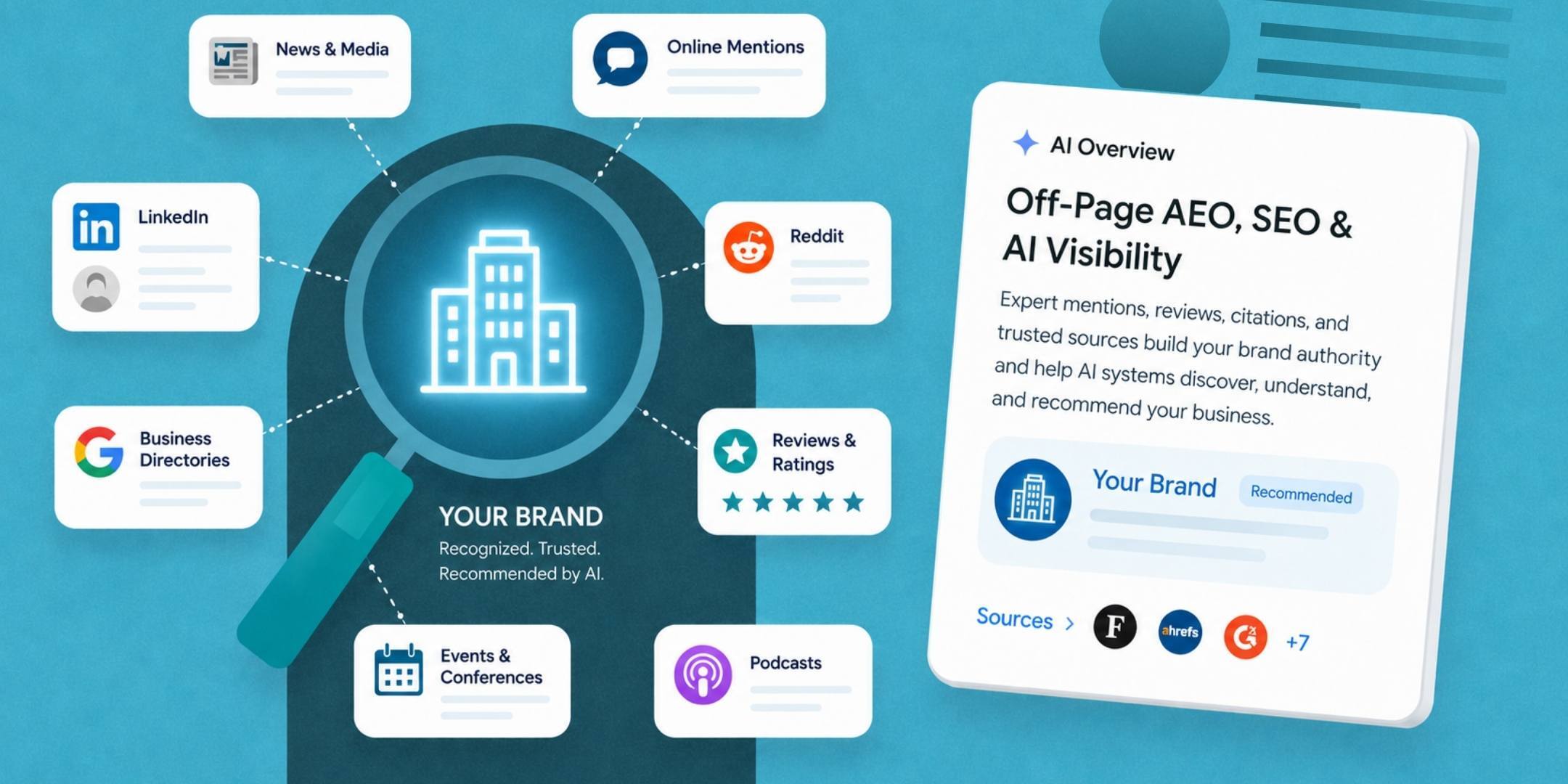
Master off-page SEO for the AEO era. Learn how entity recognition, citations, sentiment, schema, and monitoring boost Answer Engine Optimization.

AI Overviews didn't kill SEO—they exposed where it was running on autopilot. Learn why SEO as content marketing is thriving and how to adapt your...

Generative AI is disrupting Google’s dominance. Discover how zero-click search and new user habits are reshaping digital marketing forever.